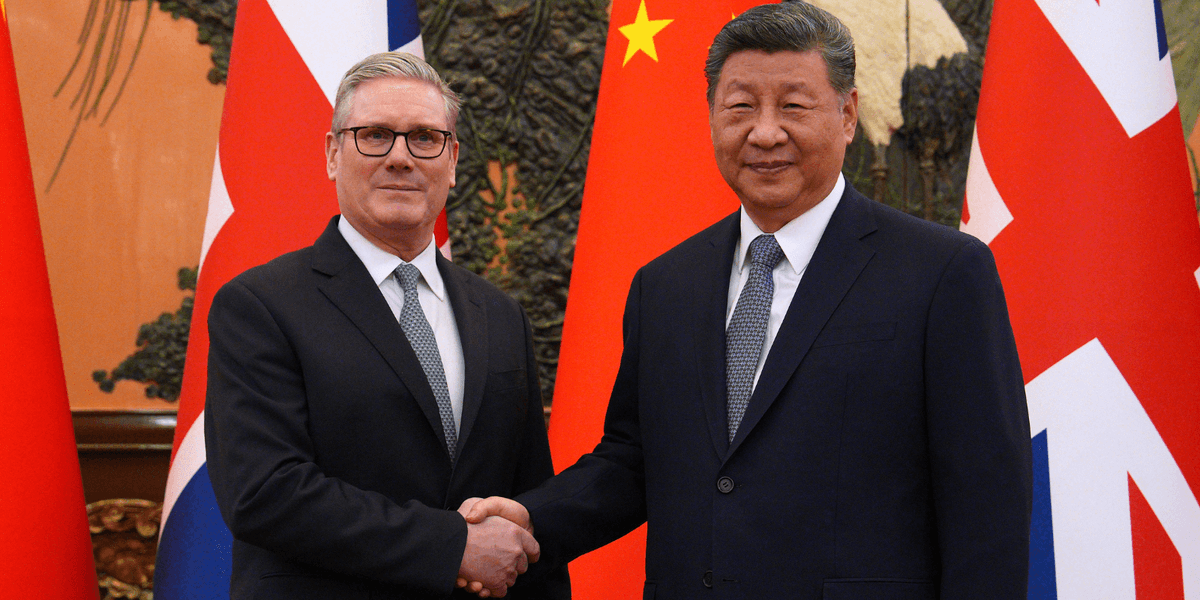




Sir Keir Starmer is set to strike a new border security pact with China in a fresh bid to tackle Britain’s small boat crisis.
The deal, which will be signed following the Prime Minister’s meetings with Chinese President Xi Jinping and Premier Li Qiang in Beijing today, will see the two countries work together to crack down on Channel crossings.
The Government said more than 60 per cent of all small boats used by smuggling gangs last year were found to be branded as Chinese-manufactured engines.
Inflatable dinghies used in small boat crossings, often made using parts sourced in China, are used by gangs to pack larger numbers onto single vessels, with recent Channel crossings found to be carrying over 100 people.
Under the agreement, UK law enforcement agencies will work with Chinese authorities to prevent small boat engines and equipment used in Channel crossings being used by criminal gangs, the Government said.
This will include sharing intelligence in order to identify the supply routes of smugglers and engaging with Chinese manufacturers.
The Prime Minister said: “Organised immigration crime and the business model of the smuggling gangs goes beyond borders and our approach to shut them down must do the same.
“This deal will help us cut off the supply of boats at source – stopping crossings before lives are put at risk and restoring control to our borders.
Sir Keir Starmer is set to strike a new border security pact with China to tackle small boat crossings
|
PA
“This is Britain back at the top table, delivering real results for the British people through our international relationships.”
The deal will also see the two nations agree to step up the removal of people with no right to be in the UK and crack down on Chinese gangs manufacturing synthetic opioids.
Rick Jones, Deputy Director at the National Crime Agency, said: “This agreement will enable us to work with Chinese law enforcement to tackle those gangs who exploit the most vulnerable, and prevent legitimate companies being drawn into this criminality.
“We are committed to working with them constructively going forward.”
65,647 people have crossed the Channel since Sir Keir came to power
|
PA
Shadow Home Secretary Chris Philp said Labour has “tried gimmick after gimmick” to tackle small boat crossings.
“The fact is that Labour cancelled the Rwanda removals deterrent before it even started,” he said.
“Illegal channel crossings have surged since the election as a result. Labour has tried gimmick after gimmick – first claiming to smash the gangs, then a ‘one in, one out’ deal that saw 41,000 arrive and only 281 removed.
“None of this has worked, and neither will this. The Conservative plan is the only one that will work – leave the ECHR (European Convention on Human Rights) enabling every illegal immigrant to be deported within a week of arrival.
“Then the crossings will soon stop.”
Shadow home secretary, Chris Philp, said Labour has ‘tried gimmick after gimmick’ to tackle small boat crossings
|
PA
Ministers will hope the agreement helps cut the number of people crossing the Channel in small boats, something Labour has promised to reduce significantly by the next election.
So far, the crossings have continued, with 933 people making the journey already this year, bringing the total since Sir Keir came to power to 65,647.
Sir Keir’s visit to China marks the first by a British Prime Minister in eight years.
The trip also follows the controversial approval of a new Chinese embassy in London.
Critics had called on the Government to reject the plans over security concerns, with local residents raising money to launch a judicial review against the project.
MI5 also warned that it is “not realistic to expect to be able wholly to eliminate each and every potential risk” linked to the new embassy.
The Royal Mint Court site sits just a stone’s throw away from critical data cables, crucial for financial sector communications between the City of London and Canary Wharf.
Security Minister Dan Jarvis, however, said he was “assured that the UK national security is protected” and any risks posed by the new embassy were being “appropriately managed”.